Commissioning closeout is often where a well-managed project can become unexpectedly difficult.
By the time a project reaches its final stages, most testing may be complete and systems may be operational, but unresolved deficiencies, incomplete documentation, outstanding corrective actions, and unclear ownership can slow down final acceptance. When these items are managed through spreadsheets, email threads, PDFs, or handwritten notes, teams can spend significant time simply determining what is still open and who is responsible for resolving it.
A digital issue log creates a more structured path to closeout by giving the commissioning team a centralized, real-time record of deficiencies and their resolution.
The Challenge With Traditional Issue Tracking
Commissioning produces a large amount of information throughout a project. During inspections, functional testing, equipment startups, and system verification, teams may identify issues ranging from minor documentation gaps to significant performance deficiencies.
Traditional issue tracking methods can make these findings difficult to manage.
A spreadsheet may work early in a project, but as the number of issues grows, teams can quickly encounter problems such as:
- Multiple versions of the same issue log
- Inconsistent descriptions and status updates
- Missing photos or supporting documentation
- Unclear responsibility for corrective actions
- Difficulty determining which items are actually ready for closure
- Significant manual effort when preparing reports for owners and project stakeholders
These challenges become especially visible during closeout, when the commissioning team needs to demonstrate that outstanding issues have either been resolved or clearly documented.
A Single Source of Truth for Commissioning Issues
A digital commissioning platform allows teams to manage issues in one centralized system instead of distributing information across separate spreadsheets, emails, and documents.
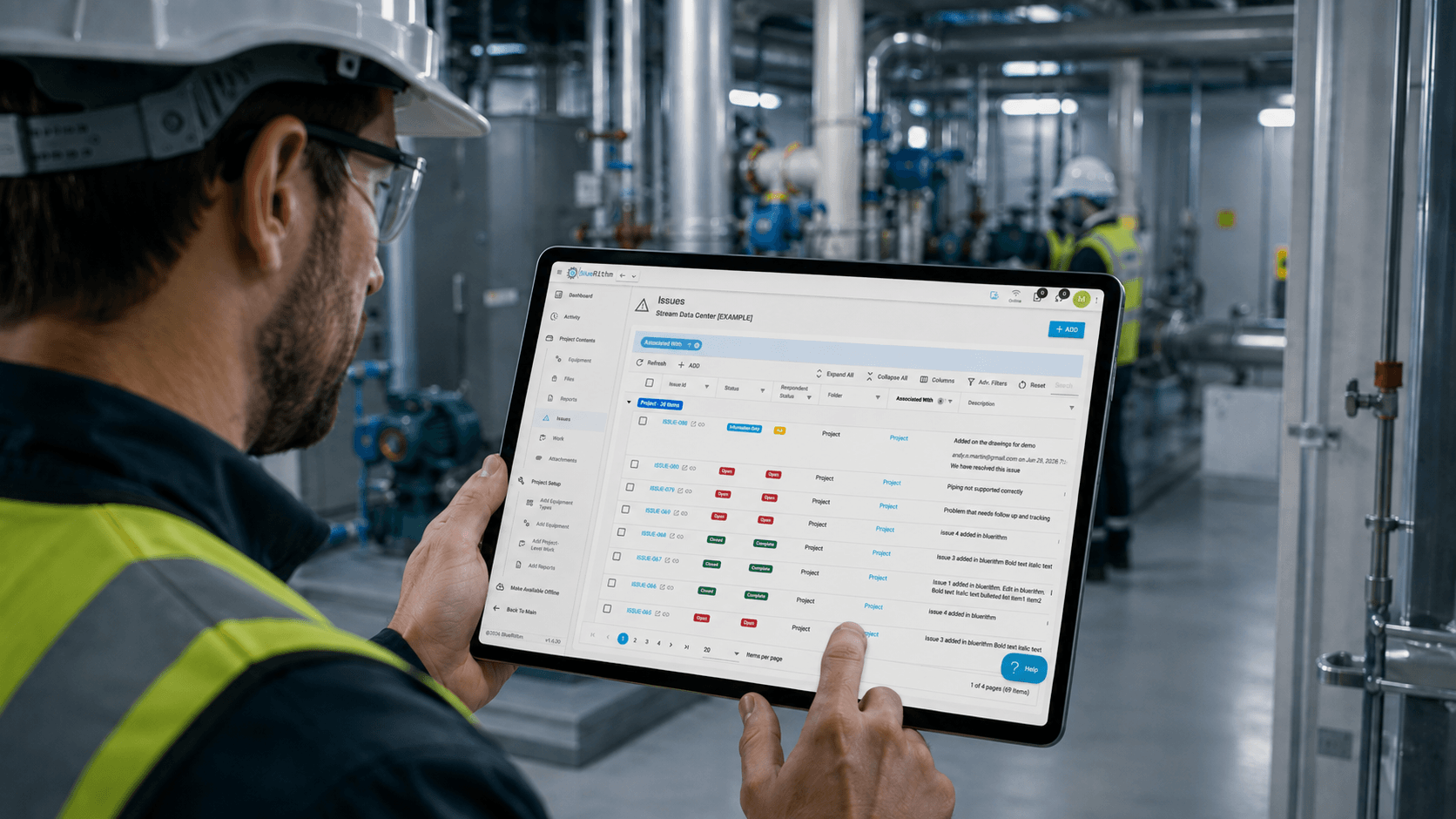
Each issue can contain the information needed to understand and resolve it, including the associated equipment or system, description of the deficiency, responsible party, priority, status, photos, comments, and supporting files.
Because everyone works from the same issue record, the team has a consistent view of what has happened throughout the issue lifecycle.
Rather than asking whether someone has the latest spreadsheet, project participants can review the current status directly in the commissioning platform.
Clear Ownership Helps Issues Move Faster
One of the most common causes of delayed closeout is unclear responsibility.
A deficiency may be identified during functional testing, discussed in a meeting, and then forwarded through several email threads before someone is ultimately assigned to correct it. Without a structured workflow, issues can easily stall.
Digital issue logs allow commissioning teams to assign responsibility directly to the appropriate contractor, vendor, engineer, or project stakeholder.
This creates clear accountability.
Teams can quickly see:
- Who owns each open issue
- Which items require action
- How long an issue has remained unresolved
- Whether corrective work has been completed
- Whether the commissioning provider has verified the resolution
This visibility helps keep deficiencies from disappearing between meetings or getting buried in inboxes.
Better Documentation of the Resolution Process
Closing an issue involves more than simply changing its status from “Open” to “Closed.”
Commissioning teams often need evidence showing what was corrected and how the resolution was verified.
Digital issue logs can preserve the complete history of an issue, including comments, photos, attachments, status changes, and timestamps. That history creates a traceable record from initial discovery through final verification.
For example, an issue identified during a functional performance test might include:
- The original deficiency and test result
- A photo showing the condition
- Assignment to the responsible contractor
- A contractor comment describing the corrective action
- Supporting documentation or an updated photo
- Verification by the commissioning provider
- Final closure
Instead of reconstructing that history at the end of the project, the documentation is captured as the work occurs.
Faster Verification and Retesting
Many commissioning issues require retesting before they can be closed.
When issue tracking and commissioning testing exist within the same digital workflow, the team can more easily connect deficiencies to the equipment, systems, checklists, or functional tests where they originated.
That context helps commissioning providers understand what needs to be verified without searching through separate files.
Field teams can also update issues directly from a tablet or mobile device, making it easier to document corrective work and verification while they are physically at the equipment.
The result is a more efficient cycle:
Identify → Assign → Correct → Verify → Close
Reducing friction in that cycle can have a major impact when dozens or hundreds of issues must be resolved before project completion.
Real-Time Visibility Into Closeout Progress
Project teams frequently ask the commissioning provider a simple question near the end of a project:
How close are we to being done?
Answering that question can be surprisingly difficult when issue information is scattered across multiple sources.
A digital issue log makes closeout progress easier to measure. Teams can filter and report issues by status, responsible party, system, equipment type, priority, building area, or other project criteria.
Instead of manually counting rows in a spreadsheet, stakeholders can quickly identify where unresolved work remains.
For example, a project team might discover that most commissioning issues have been resolved, but several critical deficiencies remain associated with a particular mechanical system or contractor.
That visibility allows the team to focus resources where they will have the greatest impact on final completion.
More Efficient Commissioning Meetings
Issue review meetings are another area where digital workflows can save significant time.
With traditional tracking methods, commissioning meetings may begin with discussions about whether the issue log is current. Team members may have conflicting versions, missing updates, or information that was communicated separately through email.
A shared digital issue log gives everyone access to the same information.
During a meeting, the team can filter the log to review only open or high-priority issues, update statuses, assign responsibilities, add comments, and document decisions directly in the system.
The issue log becomes an active project management tool rather than a static report that must be recreated after every meeting.
Easier Final Reporting
The commissioning issue log is an important component of the final commissioning record.
At closeout, owners often need documentation showing the deficiencies identified during commissioning and their final disposition.
When issues have been managed digitally throughout the project, producing that record becomes significantly easier. Instead of collecting information from spreadsheets, emails, meeting minutes, and field notes, the commissioning team can generate reports from the same data used to manage the project.
This improves both efficiency and consistency.
It also provides the owner with a more complete record of the commissioning process and any items that remained open, were accepted as-is, or required follow-up after occupancy.
Creating a Better Handoff to Operations
Commissioning closeout is not simply the end of construction. It is also the transition from the project team to the people responsible for operating the facility.
A well-maintained digital issue history can provide valuable context during that transition.
Operations teams can understand which systems experienced problems during commissioning, what corrective actions were performed, and how those issues were ultimately resolved. Instead of losing that knowledge when contractors leave the project, the information remains part of the project record.
For complex facilities and long-term commissioning programs, that historical record can become especially valuable.
Improve Commissioning Closeout With Bluerithm
Bluerithm gives commissioning teams a centralized platform for managing issues, checklists, functional testing, equipment, documentation, and project workflows.
Teams can identify deficiencies in the field, assign responsibility, attach photos and supporting information, track corrective actions, verify resolutions, and maintain a complete record of each issue from discovery through closure.
By replacing disconnected spreadsheets and email threads with a structured digital issue management process, commissioning teams can improve accountability, increase visibility, and move projects through closeout more efficiently.
The result is not just a cleaner issue log. It is a more organized, traceable, and predictable commissioning closeout process.
Ready to Simplify Commissioning Closeout?
Stop chasing updates across spreadsheets, emails, and disconnected documents. With Bluerithm, your team can manage commissioning issues in one place, track ownership and status in real time, document resolutions, and keep closeout moving forward.
See how Bluerithm can help you streamline issue tracking and close projects with confidence.